

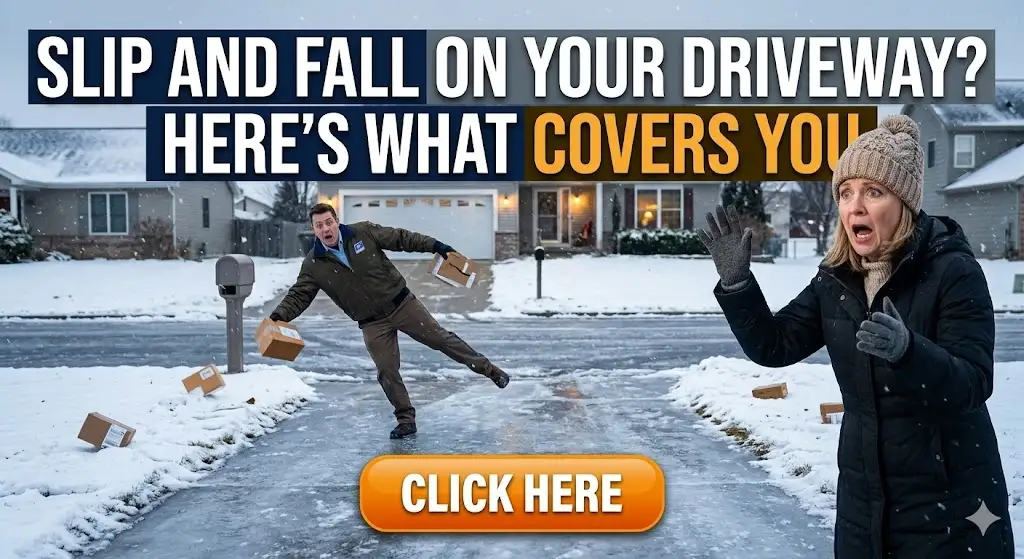
Picture this: Your neighbor slips on your icy driveway, hits the ground hard, and next thing you know — you're staring at a lawsuit. It sounds like a nightmare, but it happens more than you'd think. The good news? If you're asking does homeowner insurance cover slip and fall on driveway situations, the answer is almost certainly yes — and this article will break down exactly how that protection works, what its limits are, and when you might need more.
Why Your Driveway Is More Legally Risky Than You Think
Most homeowners think of their driveway as just… a driveway. But legally, it's part of your property — and that means you're responsible for keeping it reasonably safe for anyone who might step onto it. That includes guests, delivery drivers, mail carriers, and sometimes even trespassers.
This legal concept is called premises liability. Under premises liability law, if someone gets hurt on your property due to a hazardous condition you knew about (or should have known about), you can be held financially responsible.
A cracked concrete slab, black ice, wet leaves — any of these could be the basis of a personal injury settlement claim against you.
How Homeowner Insurance Covers Slip and Fall Claims
Standard homeowner's insurance policies include a section called personal liability coverage. This is the part that protects you when someone gets hurt on your property and decides to sue.
What Personal Liability Coverage Pays For
When a slip and fall on your driveway leads to a lawsuit, your liability coverage typically handles:
- Legal defense costs — attorney fees, court costs, expert witnesses
- Settlements or judgments — up to your policy limit
- Medical bills for the injured person — sometimes through a separate coverage bucket
Most standard policies include $100,000 to $300,000 in personal liability coverage. Depending on the severity of the injury, that range might be plenty — or it might fall short fast.
The Medical Payments Piece (And Why It Matters)
Here's a coverage feature a lot of homeowners overlook: Medical Payment Coverage (often called MedPay or "Coverage F" in your policy).
Unlike liability coverage, MedPay doesn't require the injured person to prove you were negligent. It just pays their medical bills — usually between $1,000 and $5,000 — no questions asked, no lawsuit needed.
This matters because it can resolve minor injuries quickly and cheaply, before they escalate into a full liability insurance claim. Think of it as a goodwill buffer that keeps small accidents from becoming legal battles.
What a Typical Slip and Fall Claim Looks Like
Let's say your mail carrier slips on ice at the base of your driveway and breaks their wrist. Here's roughly how the claim might play out:
- They seek medical treatment — ER visit, maybe surgery, definitely physical therapy
- They (or their attorney) contact your insurer — filing a claim under your liability coverage
- Your insurance investigates — was the hazard your fault? Was there negligence?
- A settlement is negotiated — or, less commonly, it goes to court
- Your policy pays — up to your coverage limit; you pay anything above it out of pocket
The average personal injury settlement for a slip and fall with moderate injuries can range from $15,000 to over $100,000. Severe injuries — broken hips, traumatic brain injuries — can easily push well past that.
When Standard Coverage Isn't Enough
This is where a lot of homeowners get caught off guard. Your standard homeowner's policy has limits. If a court awards the injured party $250,000 but your liability coverage caps at $100,000 — you're personally on the hook for the remaining $150,000.
That's where an Umbrella Insurance Policy becomes your best friend.
What Is an Umbrella Policy?
An umbrella policy is extra liability coverage that kicks in after your underlying homeowner's policy limits are exhausted. Most umbrella policies start at $1 million in additional coverage and cost surprisingly little — often $150–$300 per year.
For the cost of a few dinners out, you can protect your savings, your home equity, and your future income from a single bad slip-and-fall lawsuit.
Who should seriously consider umbrella coverage?
- Homeowners with long driveways or property hazards (uneven pavement, steep slopes, no handrails)
- Anyone in a colder climate where ice and snow are seasonal risks
- People with significant assets — savings, investments, a paid-off home
- Landlords or anyone with high foot traffic on their property
Does It Matter Why Someone Fell on Your Driveway?
Yes, a lot actually. Insurers and courts both look at fault when handling a slip-and-fall claim.
Factors That Work Against You
- You knew about a crack, ice patch, or hazard and didn't fix it
- You failed to salt/sand during winter conditions
- There was poor lighting at night
- You ignored a repair for a long time
Factors That Work in Your Favor
- The hazard was sudden and unforeseeable (ice formed overnight)
- The person was trespassing or ignoring posted warnings
- The injured party was partially at fault (wearing inappropriate footwear, distracted by phone)
Most states use comparative negligence rules — meaning if the injured person is found 30% at fault, your payout is reduced by 30%. Some states still use the older contributory negligence standard, which can bar recovery entirely if the victim bears any fault. Knowing your state's rules matters, so checking with a local attorney is worth it if a claim seems serious.
Steps to Take Right After Someone Falls on Your Property
Fast action protects both the injured person and your legal position.
- Call 911 if the injury is serious — don't skip this step
- Document everything — photos of the driveway, lighting conditions, weather, any hazards (or the lack thereof)
- Get witness information — neighbors, anyone who saw what happened
- Don't admit fault — be kind and concerned, but avoid statements like "I knew that spot was dangerous"
- Notify your insurance company promptly — delays can complicate your claim
- Preserve any evidence — don't fix the hazard until it's been documented
How to Reduce Your Risk Before an Accident Happens
The best defense is preventing the fall in the first place. Here are practical steps every homeowner should take:
- Seal and repair cracks in your driveway annually
- Install motion-sensor lighting along walkways and the driveway edge
- Keep salt and sand stocked before winter hits — and use them
- Add grip strips or textured paint to sloped driveways
- Trim overhanging trees that drop leaves or branches onto walking surfaces
- Post visible warnings if any hazard can't be immediately fixed
Proactive maintenance also helps your case legally — it shows you took reasonable steps to maintain a safe property.
Reviewing Your Homeowner Policy: What to Look For
Not all homeowner policies are created equal. Pull yours out and check these key details:
| Coverage Type | What to Check |
|---|---|
| Personal Liability | Is the limit at least $300,000? |
| Medical Payments | What's the per-person cap? |
| Exclusions | Are there carve-outs for business activities? |
| Umbrella Eligibility | Does your insurer offer one? |
If your liability coverage feels thin, this is a great time to call your agent and ask about increasing limits or adding an umbrella policy. It's one of the most cost-effective ways to protect everything you've built.
The Bottom Line on Driveway Slip and Fall Coverage
Dealing with a slip and fall on your driveway lawsuit is stressful — but you're probably better protected than you realize. Your homeowner's liability coverage is designed exactly for this kind of situation. Pair it with Medical Payment Coverage to handle small claims quickly and a Umbrella Insurance Policy for serious ones, and you've built a solid defensive wall around your finances.
The key takeaway: don't wait until someone falls. Review your policy limits now, fill any gaps, and take basic steps to maintain a safe property. That combination — coverage plus prevention — is what actually keeps you protected.
Thanks so much for reading! Got questions about your specific situation, or has something like this happened to you? Drop a comment below — your experience might help another homeowner avoid the same headache.
For more on protecting your home and finances, check out our guides on umbrella insurance basics and what homeowner insurance actually covers. For official policy definitions, the Insurance Information Institute is an excellent resource.